
This morning, October 1st 2026, I want to take time to highlight the words written by Vineyard Canada regarding the work beyond September 30th for our Churches.
I have chosen to use their wording, as it gets to the point very well, and is on par with what we as Winnipeg Centre Vineyard can stand behind for our own community.
“And then September 30 will pass.
- The orange shirts will go back into the closet and the candles will be blown out, but the stories remain.
- The specific prayers for September 30 will end, but our prayers for healing and reconciliation continue.
So what could some next steps be?
The Truth and Reconciliation Commission of Canada gave all Canadians 94 Calls to Action. As the Church, and as people who follow Jesus and are committed to justice, we were also given specific Calls to Action.
The Calls to Action remind us that reconciliation is not something that belongs only to the churches that operated residential schools. It is a call to the whole Church.
As representatives of Jesus in our own time, we are invited not to distance ourselves from this history because we weren’t there. We are called to bring the presence and love of Jesus into the work of reconciliation by listening, learning, acknowledging what has happened, seeking justice and coming alongside Indigenous peoples with humility.
So what might this look like for a local church like ours?
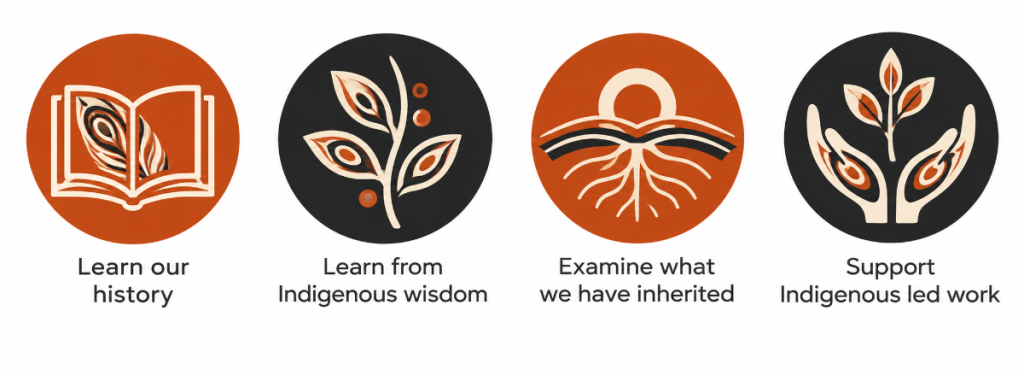
- Learn our history. Call to Action 59 calls churches to help their congregations learn about the church’s role in colonization, the history and legacy of residential schools, and why apologies were necessary. For us, that means being willing to learn rather than assuming this history belongs to someone else’s church.
- Learn from Indigenous spirituality and wisdom. Call to Action 60 calls churches and other faiths to work with Indigenous spiritual leaders and Survivors to educate clergy and staff about Indigenous spirituality, the legacy of residential schools, religious conflict and spiritual violence. For us, this means taking responsibility for doing our own learning rather than expecting Indigenous people to educate us. And when we are invited to learn directly from Indigenous people, we approach them with humility, recognizing that we have much to learn and little to presume.
- Examine the beliefs and practices we have inherited. Calls to Action 48 and 49 ask faith groups to adopt UNDRIP as a framework for reconciliation and to repudiate concepts such as the Doctrine of Discovery and terra nullius that were used to justify European sovereignty over Indigenous lands and peoples.
- Support Indigenous-led healing, culture, education and relationship-building. Call to Action 61 calls church parties to establish permanent funding for community-controlled healing and reconciliation, culture and language revitalization, education and relationship-building projects, and regional dialogues led by Indigenous people.
The Calls to Action give us places to ask:
- What do we need to learn?
- What do we need to acknowledge?
- What might we need to change?
- Who might we listen to?
- How might we come alongside what Indigenous people are already doing?
Take some time to remind ourselves of the specific Calls to Action for the Church: Read the Truth and Reconciliation Commission’s Calls to Action“
May we, as Winnipeg Centre Vineyard, see the work in front of us (quite literally outside of our church doors) and continue to listen and learn.