Christmas at the Vineyard, 2017

Hey folks! So the Christmas season is upon us once again! (Hold on as I pour myself another mug of eggnog).

Below are a few events I’d like to highlight that will be happening at the Vineyard for this 2017 Christmas season:

  • Our kids and youth will be leading us in worship and throughout the morning on December 10th for our annual Kids Service Sunday.
  • On December 17th right after the service we want to celebrate and feast together as a family and community for the annual Christmas Feast!
  • On December 24th, as it is both a Sunday and Christmas Eve, we will gather in the morning for a shortened Christmas Eve Service from 10-11:15 a.m. Please note there will be no evening service on this day.
  • We will also have a shortened service on December 31st from 10-11:15 a.m. for a New Year’s Eve Service.

Through all the hustle and bustle that the Christmas season brings, let’s remember our Centre, whom we are celebrating.

Blessings!

Metanoia Reflections

I had the privilege to be involved in Vineyard Canada’s Metanoia West gathering in Langley about a month ago. It was a great time of coming together with other Vineyard friends from across the Prairies, the North and BC. We gathered in the historic Friends Langley Vineyard. It seemed significant that we were there in the first Vineyard in Canada, which birthed so much. Yet, we weren’t nostalgic, nor caught in sentiment. There was a palpable sense not only of God’s presence with us, but his passion, excitement and vision for us as a Vineyard family in Canada for the future. Building on a wonderful foundation – and continuing. How do we continue well? What is he inviting us into? Who has he specifically called us to become? How might God be inviting us to reimagine our future? Who are we becoming as we practice following the way of Jesus? – all questions that were asked and that I’m left asking. Answers will come as we continue to follow Jesus and pursue his Kingdom.

Below are videos of the first two sessions. The first is David and Anita Ruis orienting us around the theme “Health Begets Health”. The second is Jared Boyd unpacking the Sermon on the Mount. He does a great job taking a second look at these verses that are quoted so often, yet mostly misunderstood and misapplied. There are two other sessions available here.

I was there representing WCV, part of the Regional Leadership team, and as a national catalyst for Vineyard Engage.

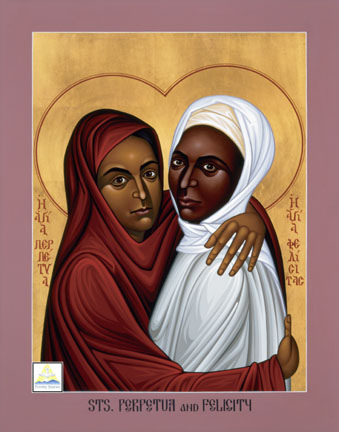
Jesus: The Song of St. Perpetua

For my birthday last year, Jennifer (my wife) bought me a lovely edition of the 1954 volume called “Lives of Saints.” One of my favourite accounts is of St.Perpetua, a twenty-two-year-old who was martyred for her faith in the year 203. Perpetua was married and had an infant; she was one of five catechumens (those at the time who were being prepared to be received into the Church but had not yet been baptized) who were arrested for their faith and imprisoned.

During the subsequent trial, Perpetua’s father appeared with her child in his arms. He pleaded for Perpetua to deny the faith, imploring her to “have pity on the child.” Nonetheless, when the judge asked her “Are you a Christian?” Perpetua said “Yes, I am.” When the group was sentenced and led into the amphitheatre where they would eventually suffer death by wild animals and gladiators, Perpetua was singing.

In the last two weeks, the lectionary has featured several passages which resonate with our current sermon series (Fixed On Jesus: how to hold the centre in an age of diversity). In one particular passage, Jesus clarifies the practical (and radical) implications of having him as the centre of our lives:

Luke 14:26-27: “Whoever comes to me and does not hate father and mother, wife and children, brothers and sisters, yes even life itself, cannot be my disciple. Whoever does not carry the cross and follow me cannot be my disciple.” Later, in verse 33: “None of you can become my disciple if you do not give up all your possessions.”

These days – without the threat of wild animals and gladiators, and given the prevalence of much cushy Christian pseudo-psychology that masquerades as authentic spirituality – many of us come to (or stay with) Jesus believing that our most cherished relationships, life, and possessions can remain happily uninterrogated. It’s especially tempting to minimize or altogether ignore the part about carrying the cross; to forget that the way of Christ is the via Dolorosa.

In the passage above, Jesus is straightforward and unapologetic: it’s impossible to follow him without cost, and the cost is everything. I love the great Catholic writer Flannery O’Connor’s take on this reality:

“What people don’t realize is how much religion costs. They think faith is a big electric blanket, when of course it is the cross. It is much harder to believe than not to believe.”

The “hate” of family and life itself that Jesus speaks of is comparative. The idea is that we’d love him so passionately that our attachment to everyone and everything (including all we own and all our cash) would, by comparison, seem like hate. Paul’s words in Philippians 3:8-9 convey the beauty and power of this movement: “What is more, I consider everything a loss because of the surpassing worth of knowing Christ Jesus my Lord, for whose sake I have lost all things. I consider them garbage, that I may gain Christ and be found in him […].”

The real heart of Jesus’ words in Luke is an invitation for us to experience, over and above anything and everything, his “surpassing worth.” Experiencing him this way is the only thing that evokes the kind of love for and devotion that obscures everything else. If we shudder at the cost of being without the dearest people, things, or whatever-it-may-be in our lives, it’s likely because we have not yet fully experienced the immense, satisfying, and incomparable joy of Jesus. Gaining and being found in him is having everything, and more.

It’s entirely possible to accept Jesus’ invitation and centre our lives on him in this way. Perpetua’s family, possessions, and very life – significant though they were I’m sure – were negligible compared to the pricelessness of having Christ. I imagine that’s why, even as she “carried the cross” and was processed to her death, she was singing.

May it be that we too so thoroughly experience the unrivalled love, life, grace, and abundance found in the person of Jesus alone that following him – regardless of any and all cost – remains a perpetual song of joy. After all, if we have everything, there’s nothing else we need.

Fall Series – Fixed On Jesus

Diversity is Great but has Some Challenges

We live in a time of immense diversity. Every subject imaginable has a myriad of opposing viewpoints – from politics, economics and science, to arts, religion, sports and more. As if that weren’t enough, adherents to virtually any opinion can find facts and figures to back up their position, adding emotional horsepower to whatever position they hold. Of course, the church isn’t immune from this. Theology can be politicized to the point where it manifests itself in people doing ugly things in the name of truth. How should the church hold to what is true in times like this? What are we to believe? How are we to behave toward each other and toward those who are not yet following Jesus? What are we to do with diversity within the church?

Thankfully, the church has always lived in diverse times.  It is true that today we may face some new challenges, but ever since the birth of the church there have been controversies they’ve had to work through. In fact, much of the New Testament contains stories, advice and even warnings to the early church regarding how to conduct themselves in the mist of differing ideas. Furthermore,  the New Testament church didn’t figure it all out and usher in a period of unity and uniformity (those aren’t the same, by the way!). The past 2,000 years of the church is full of all kinds of controversy. At times, this diversity has led to divisiveness – in the extreme it’s even become violent. In other instances, the church has managed to stay true to what its called to do: to love God and love each other like we love ourselves (Mark 12:30-31) and to make disciples of all nations, baptizing in the name of the Father, Son

the church has always lived in diverse times
and Holy Spirit, and teaching them to obey all Jesus commanded (Matt 28:19). But how does one actually do this in such turbulence? What are the keys that the early church held that can help us through our times? What mistakes have been made that we can avoid? And, what authority does the Bible have in all of this?

This Fall we’ll be exploring how to hold the centre in the midst of tremendous diversity – we’ll be attempting to speak to these and other important questions for our time.

A Model:

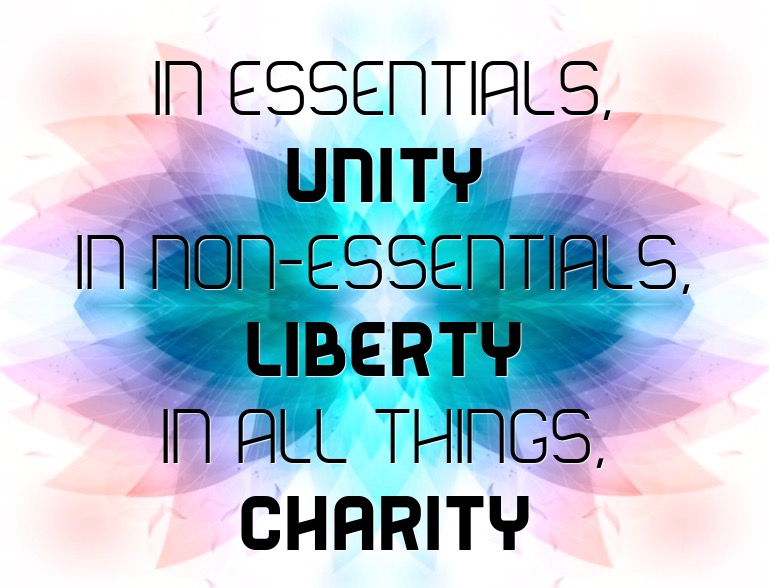
In the 17th century a German Lutheran pastor named Peter Meiderlin lived during incredibly difficult times.  The infamous 30-Year War was raging and all of Europe (almost literally) was fighting (literally) over theology. Doctrine had become politicized to the point that Christians were killing each other over points that might seem ridiculous to us today. In the midst of this, and with the help of a God-dream, Meiderlin coined a catchy little phrase (well, it’s catchy in Latin) which reads: “In essentials, unity.  In non-essentials, liberty.  In all things, charity.” In other words, keep the main thing the main thing – everything else that is not essential to salvation, even though it’s important, should not be given central priority – and love each other through it all. While this rubric didn’t put an end to the fighting of his time, it has become helpful to many Christians since.

We’re going to use Medeirlin’s phrase (although mix up the original order) as an outline for this series.  

What are the essentials that we must hold on to?

What are the “essentials” that we must hold on to? Far from nailing down a set of theological ideas, our centre is a Person – Jesus – who is both fully God and fully human. We must always keep him at the centre, and anything or anyone who begins to displace him must be named and put back in its proper place. This means that good ideas, moral ideas, holy ideas, even good theology is not our centre. They are all good, but we are not to anchor ourselves in them. Like the writer of Hebrews says, we are to “fix our eyes on Jesus, the author and perfecter of our faith” (Heb 11:1-2). Next we’ll explore how to have charity in “all things”.  In other words, how do we listen well to those we may disagree with over non-essentials? How do we love each other as brothers and sisters in Christ amidst diverse opinions, theologies, experiences and values?  Lastly, in the new year, we will begin to explore some of the many ways our community is diverse – the “non-essentials” – which may still be important, but just not our centre – not what defines us. At our annual retreat in the Spring, the elders identified 12 issues (and there are likely more) in our church that people will deeply disagree with others about. However, before we get there, we must keep the centre in view and always posture ourselves in love.

Resources:

We will be compiling some additional resources for those who want to go deeper.  For now, here is an article by Gary Best (former director of Vineyard Canada) called “Unity and Truth – A Historical Reflection”. We’ve found Gary to be very helpful in setting the tone for this conversation. In this article, he articulates how one should be concerned with taking a good posture before taking a position on any given topic. Check it out and let us know what you think either in the comments below, or by contacting any of the pastors or elders.

Notes:

>> This series may bring up some anxiety in some of you. If this is the case, please, please, please find a healthy place to process. The Pastoral and Lay Elders have been praying for this process for some time now and are all prepared to provide support and care where needed.

>> Both the Upstairs Gatherings and Downstairs Gatherings will be exploring the same topics throughout this series.

“…And let us run with perseverance the race marked out for us, fixing our eyes on Jesus, the pioneer and perfecter of faith…” 

Hebrews 12:1-2


Two Psalms by Brent Woelke

The first Writer’s Circle happened last Friday. A lot of great material was shared. Here are two modern day psalms that Brent shared.

If you were to write and pray your own psalm to the Lord, what would you say?

The next Writer’s Circle is November 24th.

A Lament

The hand of the Lord is on me,

for I am still being broken.

Who can I call to for rescue?

Who can pull me from your grasp?


The Lord has humbled me,

The Lord has brought me low.

What more can be taken from me?

What more can be stripped away?


Everything I had hoped for in the Lord

is in cardboard boxes.

Everything I loved

is sold or is sitting in the back lane.

Everything I cherished

has walked away;

it mocks me, speaking lies and accusations.


But the Lord will be my judge.

He has weighed my actions

He has determined my punishment.

Who will come to defend me?


My friends gather around me,

they look upon me in silence.

They whisper about me,

for you have exposed my sins.


They say,

“Here is one who trusts in God,

here is one who calls on Jesus’ name.”


A Song of Ascent

My son, consider the path of God.

His laws are stones that ascend His mountain.

Study and search so that you may find your way.


For His path is not obvious or straight

and all who approach Him must toil and labor.

The path of His Son is a path of suffering.

See now that His blood lines the trail,

His precious blood shows the way.

Has He not placed every stone before you?

Every rock as a firm foundation under your feet

every boulder as an obstacle and trial to overcome.


Take heart in your time of need.

Call out so your strength is failing.

For all who seek Him, shall be found by Him.

All who look to Him, will be lifted up.


For the Lord is high above all the earth.

He sees all who travel upon His hill.

None escape his sight,

and all things are subject to Him.

The very roots of the mountain are in His hands.

The mountains rise and fall by his decree.


But those who trust in the Lord will not fall.

Those who fear Him shall behold His majesty.

 

New Elder Process & Invitation

In the Vineyard elders function as overseers who tend to the spiritual health and vision of the community.  At this juncture we’d like to add to our current Elder team and your input and prayer is critical.

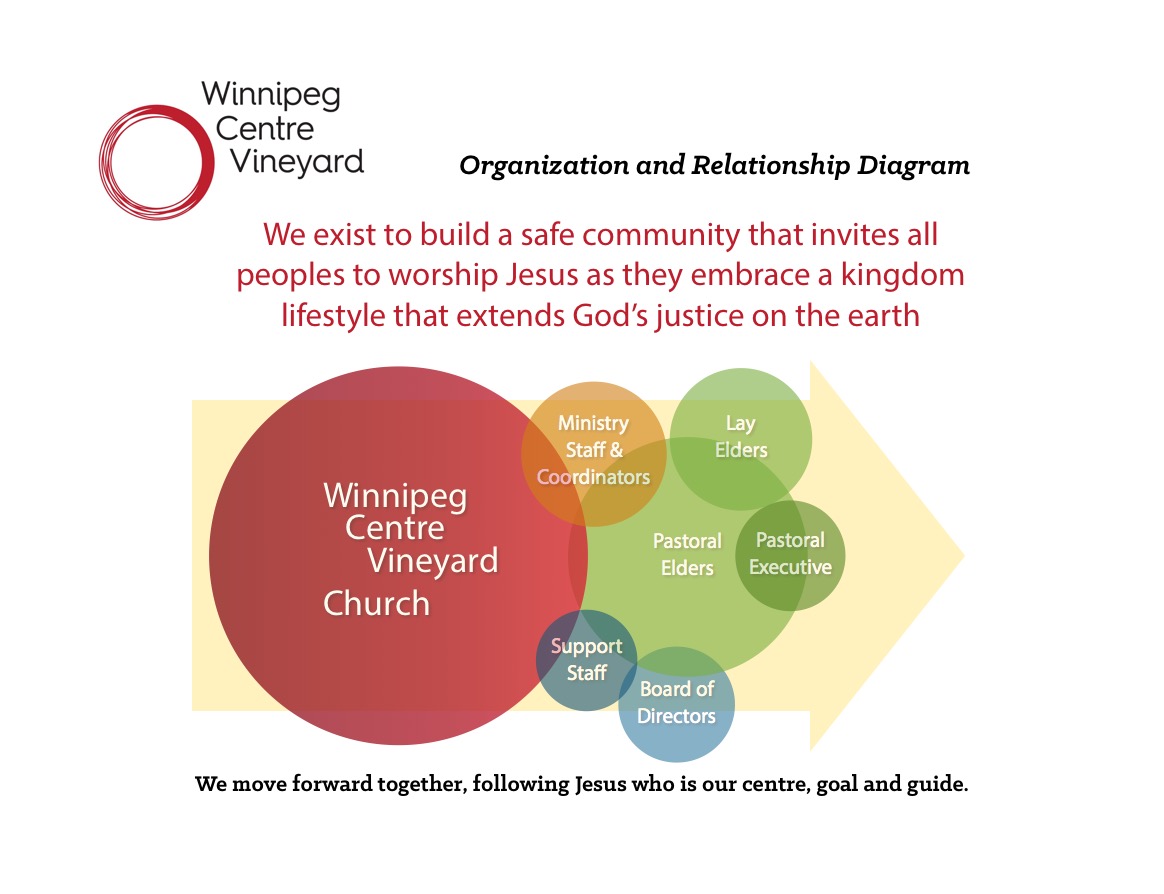
There are two kinds of elders in Winnipeg Centre Vineyard – Pastoral Elders and Lay Elders.  The Lay Elders (Paul & Sherry Ansloos, Cliff & Krista Heide, Jason & Theresa Eheler, Rod & Elisa Jersak) keep the big picture in mind and prayerfully seek God for direction and counsel regarding all macro matters relating to church-life. The Pastoral Elders (Riegers, Woods, Rademakers & Labuns) also embrace this role with the added responsibility of implementing the daily tasks associated with the macro. The whole Elder team is lead by the Pastoral Executive (Nathan & Andy). More on leadership in WCV here.

A few points to keep in mind in this process:

  1. Leadership is servanthood. It’s not about ordering others around, but rather serving others (Luke 22:25-27). Being an elder isn’t a promotion. Rather, it’s a recognition of a person’s current influence in the community.
  2. Leadership is action. It’s not about position or titles. While specific roles can be very helpful, true leadership is never about titles. If a someone has a position of leadership, but doesn’t have anyone following, then they’re just going for a walk.
  3. The Elders, while not always older, are all seasoned leaders and followers of Jesus.
  4. While all the current elders are married couples, this is not a requirement for prospective elders, nor is it necessarily preferable.
  5. Lay Elders meet monthly, participate in one annual 2-day retreat, and commit to a 3-year term which is renewable based on mutual agreement by all current Pastoral and Lay Elders.

There are four steps in the process of adding new elders to our current team.  There are also a number of considerations and requirements for elders.

The New Elder Process is:

  1. Nomination and Discernment (November). During this time the community and the current elder team nominate those they think are currently functioning as elders (even if they don’t have the position). Prayerfully ask, “who do I naturally look to for counsel, support, care, etc?” Chances are, those are the people who are already functioning as elders. At the same time, the pastors and elders are prayerfully discerning if people qualify and are a good fit for the current team and season of life the church is in (see below for requirements and considerations).
  2. Proposal & Mutual Consideration (December). The staff will contact potential new elders and invite them to prayerfully consider.  This is a period in which we see if this “seems good to us and the Holy Spirit” (Acts 15:28).
  3. Prospective Elder Period (January – March).  This is a three-month period during which prospective elders are known to the community, come to monthly elder meetings, and are in communication with staff.  We “kick the tires” so to speak. At the end of this period it’s determined if it’s a fit.  If it is:
  4. Membership Vote (March).  Those who are formal members of WCV (those who “belong, serve and give” as described here) vote on the prospective new elders. If the new elder is ratified, this begins their 3-year term. Bear in mind that this is a vote, not on who should become elders, but on whether those who’ve been identified via the above process are the right decision for the Vineyard at this time.

Requirements for Elders are:

  1. All the biblical requirements outlined in 1 Timothy 3 and Titus 1.
  2. Be a current member of WCV (described here). Walking out and dialoguing with our 15 Core Practices. Of particular note are: Devotion to Jesus (elders should be devoted to their walk with God), Circles of Sharing (a hallmark of eldership is hospitality) and Generosity (elders should be giving to the local church).
  3. A good fit with the current team and the season the Vineyard is in. While there are many people who generally qualify as elders, the staff and current elders must prayerfully discern who is the best fit for right now. What skills and gift mix will best suit the team already? This is not a popularity contest – it is a serious process to discern who God has prepared and gifted to serve the whole community at this time.

>>Will you join us in this process?  We value both your prayer and input.  If you’d like to nominate someone please contact one of the pastors or email or call the office. Thanks!

For a further explanation of this Organizational Diagram go here.

Our current Elder team (both lay and pastoral elders):